A shortened version of this article was published in the Brooklyn Daily Eagle (https://brooklyneagle.com/articles/2024/07/11/a-secret-garden-grows-in-brooklyn/) Below is the full piece I wrote.
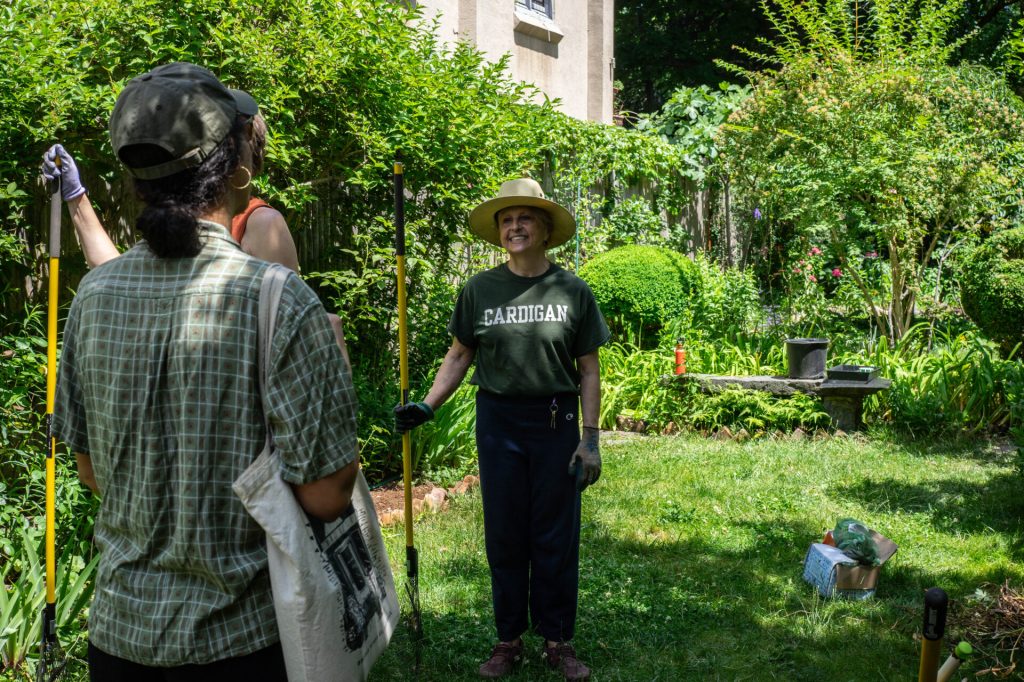
COBBLE HILL — Walking through the garden together, Julia Lichtblau is able to identify every plant with its traditional Latin terminology; euonymus fortune, Heuchera, phlox paniculata, hosta plantaginea.
As we were talking, passersby frequently stopped to peer into the space, which is separated from the sidewalk by a large, barbed wire fence; the garden looks more like it belongs in the British countryside than in the midst of a densely packed American city.
The Secret Garden project began long before the neighborhood of Cobble Hill became synonymous with the terms gentrification and luxury. The land that the carefully designed plants rest on was once an empty junkyard lot, bought by Englishman Christopher Adlington in the year 1970. Back then, the neighborhood was Italian, Catholic, and Brooklyn through and through.
For forty-five years, Adlington tended the garden that he had built on that old plot of land. He was there almost every day, pruning, weeding, and planting. Visitors were rarely allowed to enter his space.
In 2001, Julia moved into the old church next door to Adlington’s garden with her family. She tended to her own green space, and despite their overlapping interest in gardening, it took almost 10 years for the two to become friends.
In 2015, Christopher passed away from cancer. His partner, Nat, held onto the garden, but since he lacked the ability to tend the space to Christopher’s standards, it became overgrown and unrecognizable. Julia stopped by periodically to help but did not have the time to dedicate herself to the space entirely.
Eventually, she decided that an extra pair of hands were necessary to keep the space pristine. She put a sign on the barbed fence that onlookers so frequently stopped at to peer into the magical space. And to her surprise, a dozen volunteers came by the following weekend, ready to help. And so began a weekend ritual, which managed to not only survive through the pandemic, but actually prosper; as Julia says, it was one of the few social activities people could do during that time.
When Nat passed away, he explicitly stated in his will that the garden would go to the Brooklyn Queens Land trust and remain a community space: “had Nat been persuaded to sell or if his will hadn’t been explicit about his intention, a developer would unquestionably have been able to bulldoze the garden, and all the protests in the world couldn’t have stopped them,” Julia told me.
“…Even with hypergentrification, where ultra-wealthy buyers turn multi-family buildings and multiple buildings into mansions, some green space belongs to everyone in the spirit of Nat’s social consciousness.”
Thus, the Secret Garden established itself not only as a space for staring onlookers, but as a true community center for the ever-evolving Brooklyn neighborhood.
Saedi is one of the original group of volunteers. She tries to go to the garden as often as she can: “There’s a nice sort of core group of volunteers, who come pretty regularly. Julia calls them the stall works. You need to be able to count on people, [since] this is a pretty big space and to make it look nice you need regular help.”
The Secret Garden regularly holds events to help raise money for garden upkeep. Most recently, the Garden held a Jazz Solstice featuring musicians Reneé Manning and Ron Jackson. The event offered drinks, laughs, and a few hours of wonderful music for community members, who were asked to donate a recommended $25 to the organization.
Volunteers are welcome at the Garden on Fridays from 5 p.m. to 7 p.m. and Sundays from 11 a.m. to 1 p.m. The Secret Garden is located at 251 DeGraw street.
 Home
Home 
Leave a comment