By Hannah Epstein & Jessica Schott-Rosenfield
Bryn Mawr College administration has released a new set of guidelines regarding student protest on campus, limiting students’ ability to use bullhorns or occupy certain campus spaces during protests, and encouraging students to schedule demonstrations through the college’s facilities platform.
The newly released policies, titled “Guidelines in Support of Protests and Demonstrations,” were announced on Friday. In a statement to the Bi-College News, Tomiko Jenkins, the interim dean of the undergraduate college, said the rulebook was an effort to reinforce the college’s “unwavering commitment to the principles of free speech and the right to protest.” But students and faculty have called attention to the protocol’s seemingly contradictory nature, noting that it may limit Mawrters’ ability to express their political views freely on campus.
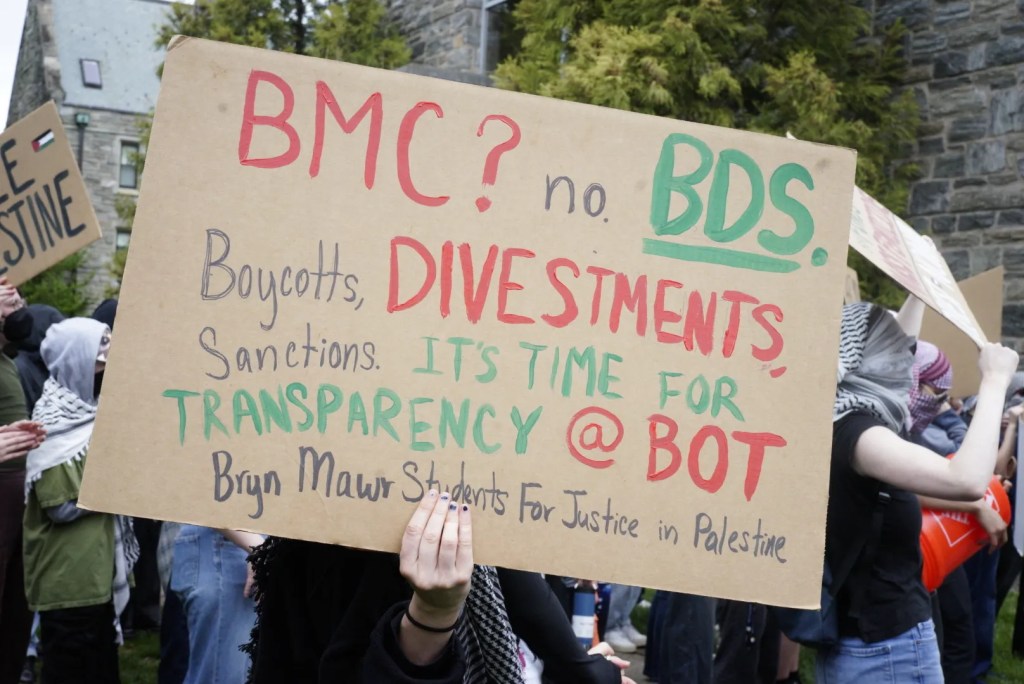
The guidelines follow from last semester’s increasingly tense political atmosphere, which reached a boiling point after student-led demonstrations led to the interim suspension of Bryn Mawr student organizations Jewish Voice for Peace and Students for Justice in Palestine. While neither organization has officially held a public demonstration since their suspension, students continued protests throughout the semester, most notably during the bi-annual Board of Trustees meeting.
Limiting Protests
The new guidelines allow students to assemble peacefully on campus spaces like Merion Green and march through pathways on campus, as long as they do not obstruct “pedestrian and emergency access,” according to Bryn Mawr’s website. However, the guidelines also note that certain spaces—such as Merion Green—must be pre-scheduled through the school’s reservation policy at least two weeks in advance. In addition, any space used “after hours” must be approved by the college’s Conferences and Events office. Demonstrations cannot be held near art installations, sculptures, and fountains. The guidelines also place an outright ban on encampments and overnight protests. Protests which are “spontaneous” are permitted; however, student organizers “should contact the College as soon as possible” when they occur.
The allowance of bullhorns and sound-amplifying devices has also been severely limited. While officially allowed, students are prohibited from using bullhorns when classes are in session, as well as when there are “college activities, or college operations on any day of the week, including weekends,” the guidelines state.

One student engaged in political activism on campus, who requested to remain anonymous due to fear of administrative retribution, said that “contrary to Bryn Mawr’s positioning as opposed to the Trump Administration, these guidelines mirror exactly how the federal government is suppressing and punishing speech.”
“It is not a question of ceasing effective protest altogether; it is a question of security and caution,” they told the Bi-Co News. “Advocates on campus will only get more secure, careful, and fortified as the administration grows more punitive. For the most vulnerable community members, protesting on campus may no longer be an option with the increased risk level and surveillance.”
When asked for clarification regarding where spontaneous protests can be held and when students are allowed to use bullhorns, Bryn Mawr’s administration declined to comment.
Some language may be restricted
Previously, Bryn Mawr’s guidelines for freedom of speech on campus permitted students to “express their ideas without hindrance, no matter how unpopular or controversial their ideas might be,” as long as they followed honor code guidelines and did not prevent individuals from attending lectures or similar events. That clause no longer exists in the current guidelines.
And while the new guidelines maintain the traditional, honor-code rules regarding limits on speech (such as prohibiting calls to violence, harassment, or threats, or targeting a specific group based off their perceived nationality, ethnicity, religion, or other protected status), an additional provision which restricts language that “threatens the health and safety of our community” has been added. The guidelines themselves offer little information on what this distinction entails, and when the Bi-Co News asked for further clarification on what kind of language would constitute a threat to “health and safety,” Bryn Mawr’s administration declined to comment.
Philosophy Professor Macalester Bell, whose research specializes on ethics and moral psychology, said in a statement to the Bi-Co News that she “would have hoped that President Cadge would share an important policy update in an in-person meeting, or, at the very least, through an email to faculty,” noting that the updated guidelines were shared through The Lantern, Bryn Mawr’s marketing office’s newsletter.
Dr. Bell noted that last semester Bryn Mawr President Wendy Cadge was “seemingly persuaded not to issue a highly detailed protest policy due to concerns about how such a policy could potentially harm both community members and the institution, only to turn around eight months later to set an extremely detailed protest policy, including several specific guidelines which many will find troubling, despite these ongoing concerns and without faculty consultation.”
Other faculty members have voiced similar concerns.
Professor Nathan Wright of Bryn Mawr’s Sociology Department wrote in response to a request for comment that “the fact that the only public announcement of these policies was buried in the middle of a routine public relations email is frankly insulting.”
“I find it deeply troubling that these policies imply the potential of surveillance of the use of college computers and suggest that constitutionally protected forms of speech off campus and on social media are now subject to disciplinary action for both students and faculty, as well as staff,” Wright said, referencing a section which stated that college-owned infrastructure could not be used to interrupt the school’s operation. “Giving the announcement the title of ‘Affirmation of Principles in Support of Protests and Demonstrations’ is the most Orwellian thing I’ve seen in my 20 years at the College.”

Professor Bell and Professor Wright both noted that the American Association of University Professors has released several statements condemning the types of policies just introduced by Bryn Mawr. A statement by AAUP published in late August of 2024 read “administrators who claim that ‘expressive activity’ policies protect academic freedom and student learning, even as they severely restrict its exercise, risk destroying the very freedoms of speech and expression they claim to protect.”
Experts on free speech protections have also noted possible concerns with the new policy.
Ryan Ansloan, a senior program counsel at the Foundation for Individual Rights and Expression, also known as FIRE, told the Bi-Co News that for the college’s new guidelines, the “devil [was] in the vagueness.”
“It’s ultimately incredibly broad and could easily be applied to anything the university doesn’t like,” Ansloan said. “[There’s] not really a defined term that would give any student the ability to know before they engage in potentially expressive activity or conduct, the ability to know that they’re about to violate [the] policy.”
And while colleges—particularly private ones—have the right to prevent students from engaging in substantial and material disruption on campus, Ansloan said that the language used by Bryn Mawr “feels kind of like a fun house mirror version of that.”
Bryn Mawr’s Honor Board is not mentioned
In the final section of the guidelines, entitled ‘Violations and Related Policies,’ Bryn Mawr notes that the college “reserves the right to modify these Guidelines when there is a reasonable expectation,” and that failure to abide by the guidelines could result in disciplinary or legal action, “including but not limited to potential suspension and citation for trespassing.”
This last section also states that if a student’s conduct “impacts the operations of the College and its property, the safety and well-being of self, others, or the community at large,” then the college administration will investigate and resolve the infraction—even if the student does not engage in behavior which is not prohibited under the Equal Employment Opportunity Provision, a federal policy that ensures fair access to education and employment.
But lacking from the guidelines is any mention of Bryn Mawr’s honor board, a student-elected panel that acts as representatives of undergraduate classes in academic and social hearings. Historically, the honor board has played a key role in deliberating and deciding on honor code violations, often working “in conjunction with the Dean of the Undergraduate College and Faculty members,” according to SGA’s website. Bryn Mawr’s administration declined to respond when asked if the honor board would also share a position in disciplinary actions taken against students who violate the new protest guidelines.
Isabelle Stid, BMC’26, who is co-head of the Honor Board and spoke to the Bi-Co News regarding her personal views on the new guidelines, said that she felt confused and frustrated following their publication.
“The guidelines seem to refer to almost a new investigation and hearing process, outside of traditional honor code or dean’s panel procedures, without clarifying what these processes are or who oversees them,” Stid said, noting that she was not speaking on behalf of the college’s honor board, but rather from her own perspective. “It is frustrating and confusing for such unclear guidelines, even unclear as to whether they supersede the previous ‘Freedom of Speech & the Limits of Dissent’ policy, to be sent out to The Lantern, a publication few students read, and for the guidelines to be seemingly created without wider community input.”
Stid told the Bi-Co News that the new guidelines were not shared with the Honor Code Futures Committee, a board she sits on, prior to their publication in The Lantern.
Administration’s Response
In a comment to the Bi-Co News, Dean Tomiko said Bryn Mawr has “updated our guidelines to allow demonstrations on campus while still ensuring students can access classes, and for labs and libraries to operate as usual. This revision is a necessary measure to uphold our unwavering commitment to the principles of free speech and the right to protest, ensuring our students can engage in essential political expression within established rules and with respect for the safety of our entire campus community.”
Update on Sunday, October 19: Comments from an interview conducted with a representative from the Foundation for Individual Rights and Expression have been added.
 Home
Home 
Leave a comment